|
INDEX:
“Who
dares to teach must never cease to learn.” -- John
Cotton Dana
First,
learn all you can about homeschooling.
Read What
is homeschooling?
Read
books about homeschooling:
Not
sure yet? Read these:
Dumbing
Us Down: The Hidden Curriculum of Compulsory Schooling by
John Taylor Gatto. by
John Taylor Gatto.
Are
you sure it won't ruin my kids? HSLDA Website.
Facts
and Trends on Homeschooling on the NHERI
Web site.
Home
Schooling: The Right Choice: An Academic, Historical,
Practical, and Legal Perspective by Christopher J. Klicka. ISBN 1929125070. Excellent
for those who are not sure whether to homeschool;
unfortunately, it's out of print. Buy used by following the link.
by Christopher J. Klicka. ISBN 1929125070. Excellent
for those who are not sure whether to homeschool;
unfortunately, it's out of print. Buy used by following the link.
The
Teenage Liberation Handbook: How to Quit School
and Get a Real Life and Education by
Grace Llewellyn. by
Grace Llewellyn.
Ready
to Get Started? Read these:
FREE! How
to Get Started in Homeschooling e-book by Cindy Downes.
A summary of what is presented here on this web
site.
Read
the homeschool laws for your state on the Home
School Legal Defense Association web site. Be sure
to read the “Legal Analysis.”
Oklahoma
home educators: Check out Oklahoma
Home Educator's Handbook published by
OCHEC.
Homeschooling
for Dummies by Jennifer Kaufeld. ISBN 0764508881.
This is one of my personal favorites. Focuses on the
basics, especially on multi-level teaching and unit studies.
The Ultimate Guide to Homeschooling (3rd Edition) by Debra Bell. ISBN 0849975751. My other personal
favorite. Focuses on the basics and college preparation.
Very balanced. by Debra Bell. ISBN 0849975751. My other personal
favorite. Focuses on the basics and college preparation.
Very balanced.
If
I Could Do it Over Again - a survey of homeschoolers
done by the Erskine Family
Things
We Wish We'd Known by Bill & Diana Waring. ISBN
1883002427. Short articles written by homeschool moms
with a lot of good advice. A must read for all homeschool
parents.
Home
Grown Kids: A Practical Handbook for Teaching Your Children
at Home by Raymond & Dorothy Moore. ISBN 0849930073.
Do you have a struggling learner? You must read this
book. This is the book that led to my son's education
success.
Learning
in Spite of Labels by Joyce Herzog. ISBN 1882514130.
Excellent resource for parents of children with learning
disabilities.
An
Education Philosophy You MUST read... Marva
Collins founded the Westside Preparatory School in 1975
in the inner city of Chicago. During the first year,
Marva took in learning disabled, problem children
and even one child who had been labeled by Chicago
public school authorities as borderline retarded.
At the end of the first year, every child scored
at least five grades higher proving that the previous
labels placed on these children were misguided.
The CBS program, 60 Minutes, visited her school
for the second time in 1996. That little girl who
had been labeled as border line retarded, graduated
in 1976 from college Summa Cum Laude. It was documented
on the 60 Minutes programs in 1996. Marva’s
graduates have entered some of the nation’s finest
colleges and universities, such as Harvard, Yale, and
Stanford, to mention just a few. And, they have become
physicians, lawyers, engineers, educators, and entered
other professions. Unfortunately, Ms. Collins died in 2015. However, her book is still available on Amazon. I strongly recommend that you read
her educational philosophy. It WILL change your thinking
about school. Marva
Collins' Biography.
Her book: Marva
Collins' Way . .
Join
a Support Group:
See Local
resources on my web site for support groups in Oklahoma.
Read
Homeschool Magazines:
The
Informer Magazine. A FREE
magazine for home educators in Oklahoma
published by OCHEC.
Practical
Homeschooling
Christian homeschool magazine by Mary Pride.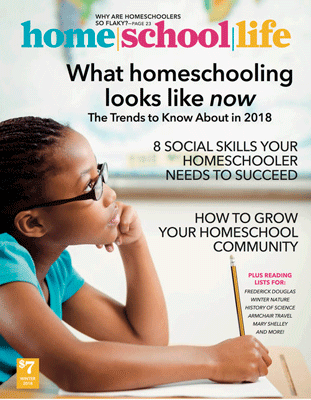
Homeschooling Today. Christian homeschool magazine.
Homeschool Life Magazine. Secular homeschool magazine. Published quarterly.
Old Schoolhouse Magazine. Christian homeschool magazine.
Do
these things with your child while you are planning:
Choose
a homeschool teaching method
Determine
your child’s needs (See Assessment/Testing)
Set
goals for the year using Goal
Setting Form (pdf document) (Examples: improve
reading skills, learn multiplication tables, improve
composition skills, work on manners, take piano lessons,
learn to type, practice ACT testing, fulfill high
school credit, improve work ethics, etc.)
Drill
weak areas in math and phonics.
Read
library books together, both fiction and nonfiction
in all subject areas
Do
art and science projects together.
Have
your child work on penmanship (elementary) or begin
a journal.
Keep
track of days spent on this in your daily log as
this counts towards your 180 days.
Use
your goals for year, Sample Curriculum
Plan, and these free planning forms to plan your
school year. (Acrobat
Reader needed to view pdf documents.):
Curriculum
Planning Form
Primary
School Planning Form
High
School Planning Form
Purchase
your curriculum after you have determined
their needs and planned your school for the year. (See Curriculum)
(top
of page)
Supplies
Needed
You don’t need a schoolroom! Schoolrooms are designed
to manage a classroom of students. Many new homeschoolers
think they have to go out and purchase a desk, blackboard,
and all the other equipment that goes in a traditional classroom
because that is how they were taught. Homeschooling is different
- that’s why it works. You can homeschool in your living
room, in the kitchen, in your backyard, at the supermarket,
and in your neighborhood park. (Thomas Edison's schoolroom
was in a tree house, in his basement lab, in the kitchen,
by the river, and on a train!) All you really need is some
very simple supplies:
Textbooks
(See Curriculum)
Paper
(type depends on age of child)
Notebooks,
pencils, pens, scotch tape, stapler, glue sticks, etc.
Art
supplies (crayons, markers, paints, brushes, etc.)
A
kitchen table is great for doing written work.
A computer is a necessity. (Teach them to type when they are about 8 years old.)
A
library card - lots of good stuff in the library and
it’s
free! A device
to play educational videos that you borrow from
the library.
TV and other electronic devices, along with apps and the internet, so you can
watch educational shows and listen to good music
A
nice, comfy sofa to snuggle up with your kids while you
read together
Older
kids usually want privacy. A well-lit desk in their room
would be good for them.
Lots
of bookshelves for all those great books you are going
to collect for your library!
(top
of page)
Removing
Your Child From School
Check
your state laws for information about removing your
child from school.
In
Oklahoma, you
may remove your child from school at any time during
the school year, but it's best to learn all you can about
homeschooling and have a plan first.
If
you have chosen to continue educating your child at home
and have never placed them in public school, you may
notify your local school district, but it is not required
by law. However, I recommend that you do so.
If
you have already enrolled your child in a public or private
school but have now decided to homeschool, we recommend
that you write a letter of intent informing the school
of this decision. This is not a legal requirement, but
it could save you problems with DHS or the truant officer.
If you have already been contacted by DHS or are in a
joint-custody situation, we strongly recommend that you
contact HSLDA or your personal lawyer for legal advise
before removing your child from school. Many schools today will help you get started in homeschooling.
A
letter of intent can be as simple as a typewritten note
stating, “Dear Sir, Please be advised that as of
(date), I will be schooling (child's name) at home. If
you have any questions, please contact me at (phone).
Thank you, (your signature)”
Date the letter and make sure that it gets to
the right person at your child's school - usually
the superintendent. Hand deliver or mail “Return
Receipt.”
 When
should I homeschool and how long should I teach each day? When
should I homeschool and how long should I teach each day?
Check
your state laws for information about teaching schedules.
In
Oklahoma, most everyone homeschools for 180
days per year. Keep
track of days in a log
book.
Included
in this 180 days are 10 days that we can use for
sick days, field trips, or teacher in-service days (include
workshops and homeschool conferences here). This is similar
to the public school.
Some
homeschoolers teach year-round taking longer or more
frequent breaks during the year. Others teach from August
to May like the schools.
Public
schools meet for five hours a day to allow time for students
to earn the required number of Carnegie Units for graduation.
A Carnegie Unit is the amount of credit given for successful
completion of a course which meets 40 minutes per day,
five days per week, for at least 36 weeks or the equivalent
time within the school year.
This
amounts to 900 hours per year. It has been estimated
by some educational professionals that out of that 900
hours, approximately 200 hours are spent on one-on-one
or on-task teaching. The remainder is spent on all the
other things that happen in schools such as correcting
papers, recess, lunch breaks, managing classrooms, etc.
That is the equivalent of 66 minutes per day! Considering
that the average homeschool family teaches one on one
approximately 1-1/2 to 3 hours per day, it's not that hard to give the equivalent education in less time. See Sample
Homeschool Schedule.
Oklahoma
public schools require 23 Carnegie Units for graduation.
As a homeschool, you can set your own graduation requirements,
just as a private school would do. However, I recommend
that you set similar standards, keeping in mind that
this can be completed using alternative scheduling and
course requirement, such as satisfactory performance
on proficiency examinations or the successful completion
of curricular units that comprise the equivalency of
a unit of work. Most homeschooler achieve more than what is required.
The
average amount of time spent on one-on-one instruction in a homeschool varies from 30 minutes/day in preschool
to 3 hours/day or more in high school.
The
remainder of the day is spent on homework (child working
on own), extracurricular activities,
character training, spiritual training, creative play,
field trips, educational projects, internships, volunteering,
and family chores.
Limit
entertainment television, video games, access to social media, and text messaging during traditional school hours. Instead, encourage them to
find other ways to entertain themselves such as reading
on their own, working on art or science projects, etc.
I kept a special “school-time activity box” stocked
with special art supplies, educational games, etc. that
the children could play with during school hours only.
This box was off limits at other times which made it a
special. Activities like this will help to increase your
child´s creativity and ability for self-government.
(Back
to top)
How
do I know my child is learning everything he needs to
know?
NO
ONE WILL EVER LEARN EVERYTHING HE OR SHE NEEDS TO KNOW!
Learning is a life-long process. What your child needs
to learn in school depends upon your child's interests,
talents, needs and career goals.
The
public schools
follow the guidelines from
national standards. Private schools
establish their own guidelines. Depending upon the state
in which you live, your homeschool may or may not be
treated as a private school. Check your laws at HSLDA
Web site.
If
homeschooling is considered a private school in your
state, like Oklahoma, you are free to set your own standards.
Some
homeschoolers
follow their state
standards (Oklahoma State Standards) or a scope and
sequence (what to teach when) published by textbook companies.
Some pick up the book, What
Your Kindergartner Needs to Know: Preparing Your Child
for a Lifetime of Learning (Core Knowledge Series).
 The
Checklist is a
scope and sequence I created specifically
for homeschoolers. The
Checklist is a
scope and sequence I created specifically
for homeschoolers.
All
of the above are good resources to have on hand, but they
are not the final word on what your child
should be taught. Children should:
- Be
taught to read, write and do basic arithmetic
- Have
a good foundation in American and world history and
science
- Be
exposed to the arts
- Participate
in physical
activity
- Learn
basic life skills such as personal finance, home and
car buying and maintenance, marriage preparation, and
child-raising
- Learn
a job skill
- Learn
social skills
- Have
a variety of additional learning experiences that focus
on the child's particular needs, interests, talents
and career goals.
Here
is a basic teaching timeline:
Kindergarten
through 6th grade: Teach basic reading, writing,
and arithmetic (See 3Rs); introduce
your child to history, science, art, music, etc. You can
do most of this with library books, hands-on activities,
and simple workbooks. Only a few textbooks are needed
at these grade levels.
Continue
working on phonics and reading practice until your
child reads fluently. (See Reading)
Continue
penmanship until your child writes in both manuscript
and cursive. (See Teaching
Handwriting)
Keep
in mind the real question is not "What grade
is my child in?" but "What basic skills
is he lacking." Once you discover what he is
lacking, select your curriculum accordingly. For
instance, if he is struggling with fractions, work
on more problems with fractions. If he has mastered
fractions, only require enough practice to review.
You do not have to do every problem or even every
page.
As
a homeschool family, you can keep
your child in the grade level that is appropriate
for his age, but use textbooks on, above, or below
grade level as needed. This may mean using a 5th grade
math book and a 3rd grade reading book for your 4th
grade child.
6th
-12th: After all basics are mastered, it's
time to prepare your child for his desired career:
college, trade school, own a business,
or go into the military or a ministry.
Work
on improving composition, explore subjects in more
depth to help your child discover his interests and
skills, and given him specific courses that will help
him meet his specific career goals.
This
is also the time to teach him home management skills,
family life skills,
and to help him to grow spiritually so that he is
ready to do what God has called him to do for his
family, his community, and his church.
If
he is finishing up high school, make sure he has the
courses he needs for graduation and for the college
and/or career in which he is interested. (See Teaching
High School.)
Make
it a priority to spend time researching
and exploring potential career goals during his middle
and high school years. (See Career
Training for more info.
A
great way to keep track of your child's education is The
Checklist.
Go
to Choosing Curriculum.
(Back
to top)
. |
|


