| |
My
Homeschool Story
 Early
Years: Early
Years:
My
homeschool journey begins with my Christian journey.
I became
a Christian in June 1981, after 30 years of atheism.
Because I was raised in a home where religion was not
talked about or practiced and in a public school where
I was taught evolution, I wanted to make sure my kids
were taught about God. So that fall, we enrolled our
son, Wil, in PreK-4 at a Christian school that used A
Beka curriculum. (At that time, we thought preschool
was essential. I definitely think this should be homeschooled!)
Wil
is a Visual/Kinesthetic learner. My daughter, Shelly, is
a Read/Write learner and very strong-willed (like her mom!).
Wil fell behind in PreK but managed to pass on to Kindergarten.
The next year, we enrolled Shelly in PreK and Wil in Kindergarten
at the same school. While Shelly flourished, Wil spent
the next few months struggling. He couldn't do the work
and the teacher was unsympathetic. She told us that he
would flunk Kindergarten.
My
husband and I were new Christians and didn't know what
to do except pray. Shortly after, we saw an interview on
700 Club with Raymond
and Dorothy Moore talking about homeschooling.
I had never heard of it. I got the book, Home
Grown Kids, read it, and found
one chapter that described my son exactly.
The
Moore's had done significant research demonstrating that
kids mature at different rates. Some are delayed in their
ability to read, write and do arithmetic because of delayed
vision development and small-motor coordination. Examples,
such as Thomas Edison, illustrate that these delayed learners
are not “learning disabled,” but are often
times extremely intelligent. Formal schoolwork for these
children is more effective if it is delayed until they
are 8 - 9 years old. Reading that gave me hope! Maybe that
was the reason for the problem!
After
much prayer, and against the advice of my parents and even
our new church family, we made the commitment to home school
for the rest of the year, just until Wil learned to read.
It was neither legal nor illegal in Delaware at the time,
so we decided to remain “undercover.” We had
not previously registered with the public schools, so we
felt safe as long as we didn't go outside during school
hours. But that was ok as we had lots to do!
Since we didn't know anyone who home schooled,
we decided to use the A Beka curriculum we had from the school.
All we had were the readers and workbooks - no teacher's
manuals or answer keys.
By
summer, I realized that A Beka was not working for us either.
So, we committed to another year of home school. I sent
off for the Moore's Seventh Day Adventist Curriculum which
included revised versions of the old Dick and Jane readers
(hamburgers were now soy burgers, etc.), and I set up the
dining room into an “official school room” complete
with school bell, black board and desk. I was ready to begin!
It
wasn't long before we hit our next roadblock. My son enjoyed
listening to the Dick and Jane readers but couldn't read.
The phonics worksheets didn't work. Handwriting was five
minutes of sheer terror. Forget arithmetic. Although Shelly
seemed to teach herself to read and loved school, she pushed
me with her strong-willed disposition. Tears flowed and
tempers flared. My friends and family kept telling us
that we were ruining our children and I was tempted to
believe it. But I kept feeling like God wanted me to
continue. In desperation one day, I called the phone
number in the back of the Home Grown Kids book and who
answered? Dorothy Moore, herself! Isn't God good! After
crying to her and explaining my situation, she said, “Cindy,
put away those textbooks and just enjoy your children.
Read to them. Do art and science projects with them.
Take nature walks.”
We spent the rest of that year doing just that. I tore down
the schoolroom. Instead, we read together on the sofa or in
the kitchen or at the park. We visited museums, did art projects,
volunteered in church, experimented with science projects,
and did housework and chores.
First grade was more of the same, but now we started taking
turns reading. I'd read a word, then he would read a word.
Later, it was I'd read a paragraph and then he'd read a paragraph.
We'd spend a few minutes a day on phonics worksheets, handwriting,
and learning numbers, but never more than five or ten minutes
at a time for Wil. Our family reading consisted of reading
the Bible through from front to back (that also took care of
ancient history and sex education!); classics such as Robinson
Crusoe, which we read in the original, un-edited version and
had to use a dictionary to define all the words; and science
and history textbooks that I found in various grade levels.
Meanwhile, Shelly was going strong and doing much more in the
way of worksheets and workbooks. It was easy for her. All this
time, we had no one to turn to for curriculum advice so I just
kept coming up with my own. I used college textbooks, fiction,
nonfiction, high school textbooks, magazines, and whatever
else I could get my hands on.
We spent much of our free time in ministry. We developed
a family puppet ministry during our early years of homeschooling,
ministering at local churches, Boy Scout troops, and nursing
homes. The kids were very active and enjoyed being involved.
Wil controlled the sound for us as well as doing puppets.
He also got interested in computer graphics making posters,
signs, brochures, newsletters, etc. which eventually led
to his life career. Shelly loves art so she created the
costumes, painted stage decor and scenery.
By
age 9, Wil still could not read above a first grade level.
I tested Shelly and Wil's reading speed and comprehension.
Shelly read at 1200 wpm/94% accurate; Wil read at 240 wpm
and 98% accurate. His handwriting was atrocious and math
- well that's another story. There were many more tears
and I often told my husband I was going to put the kids
back in school. He would respond by saying, “Ok,
go find a school you like and we'll put them in.” After
searching, I would always get inspired to home school another
year!
Wil had managed to learn numbers, counting, and how to add
and subtract very simple facts, but that was about it. We
never used history or science or grammar textbooks. We simply
read real books for those subjects and used our handwriting
practice to teach a minimal amount of mechanics (capitals,
punctuation). My goal was simply to get him to read, be able
to fill out a form, and at least do basic arithmetic. I thought
if I could get him to do that, then the rest would follow.
I did some IOWA testing on my own just to see how they were
doing and Wil tested out good in everything but reading and
math. Shelly tested out great in everything.
That summer, we zeroed in on learning multiplication tables.
All of a sudden, it seemed like a light bulb went on for
Wil! Between 9-1/2 and 10, he began to catch up. He was reading
simple books and arithmetic became a little easier. Writing
was still a chore, but he had learned enough to fill out
a form!
I taught them both to type at an early age - somewhere between
8 and 9. We got our first computer - an Apple 2e and they
both learned to type on it. Most of their writing assignments
(other than penmanship) were done on the computer. It helped
them both to be much more creative and more willing to write.
To teach them to type, I put masking tape over the keys so
they couldn't see the letters. We used an old typing textbook
for lessons. By high school, they were both champion typists!
We moved to Virginia in 1986, Wil's 4th grade, and finally
found a support group; but, since we were only going to
be there two years (ended up being three), we still home
schooled without registering with the school district.
In 6th grade, we got our first real textbook in which we
actually worked all way through - Saxon 7/6. They had just
published it. There were no lower grades at this time,
so I bought it with the idea that we would take two years
to do it. Wil had not been able to use a textbook for math
before this (other than bits and pieces here and there
and in very small doses). Shelly had been doing some A
Beka math, but it was beginning to overwhelm her, too,
so we switched to Saxon.
Middle School
By
this time, both of them were in the same level at school.
I bought Bob Jones literature (several books at once -
5th and 6th grade) and we devoured them together. We cried,
laughed, and enjoyed them so much. Unfortunately, they
have since taken out all the good stories and replaced
them with modern stories. (Get the 90's versions for some
good reading!). I had each child keep a daily diary. This
was handwriting practice. Shelly still keeps hers today.
I bought Bob Jones history and science (no teacher's manuals
or tests), which we read together and did most of the worksheets
out of the student manuals. We did lots of lab work - dissecting,
building volcanoes, tested our blood, did fingerprinting,
and whatever else we could come up with. Chemicals were
hard to find so we had to order them through my husband's
work place. We never could find a good microscope so
we used Astroslides (don't see them around anymore).
We did a lot of maps. We still did not use a grammar
textbook. This was also the time we traveled each summer
around the country doing puppet shows at malls and fairs
for a businessman in Indiana. That was quite an adventure
and a book in itself!
We moved to Pennsylvania in 1988 in time for 7th grade. God
convicted me that we needed to be legal and register with
the school. What a state to decide to do that in! It was
not yet legal in Pennsylvania and very few were homeschooling
there without problems. My husband was working for Teen Challenge
in Rehresburg, PA, and several of the staff there had been
wanting to home school. When I got there, they said, “You
can't home school here.” I said, “Wait and see.” I
sat down and wrote up a curriculum plan based on my eclectic
curriculum and a letter that stated my rights to homeschool
and marched into the superintendent's office. I informed
him that I was going to home school my children and here
were my documents. He said “ok,” informed me
of the portfolio, evaluator, and testing requirements, and
I walked out. Within the week, several other families from
Teen Challenge also decided to home school and thus began
my first home school support group which I called Mom's Night
Out.
During the time I was in Pennsylvania, Dr. Howard Richmond
was instrumental in getting more home-school friendly laws
passed, but I believe it is still a difficult state in
which to home school. Dr. Richmond was my evaluator
so he knew the value of creating curriculum to suit the
child. I was allowed to use a variety of methods. I still
have the kids' portfolios that were required in Pennsylvania
and, personally, I think this is the best way to go!
The testing requirement was scary, but by this time, Wil
was reading on level (but slow) and doing on-level math.
For 7th grade, we started using more textbooks, but still
no teacher's manuals or tests (by choice). We used Bob Jones
history and science and literature as reading; Saxon math,
and Spenserian penmanship. Wil wanted to write “perfect!” He
did well with it, but like me, will never really write pretty!
It actually hurts us to write so that is why I am sympathetic
to kids who have trouble with the process of handwriting.
It was during this time that Shelly decided she wanted to
go back to school. She pleaded and begged, but Bill and I
felt that she needed to stay home. She was going through
a very rebellious period in her life and the thought of her
in school made us decide that it was not a wise idea. There
were no schools around that I thought would suit, either.
Military school would have been appropriate!
Because we were living in the rural part of PA, it took a
lot of effort to give the kids extracurricular and social
activities. Sports involved a 30 minute drive to gymnastic
lessons with one other home school family and another 30
minute drive in another direction for art lessons with another
home school family, making a triangle trip! We did this on
Fridays as well as run errands. Wil took piano lessons; Shelly
flute and guitar. We were involved in church activities and
youth group for social functions. Every year, our family
and a few friends, would provide the children's ministry
for Teen Challenges' summer festival. Here is Wil running
cameras for one of the festivals (probably 1989) and his
wedding photo in 2003.
 space space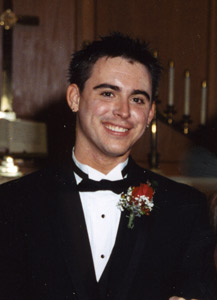
Wil
at age 15 and 23
High
School Years
In
1991 (9th grade), we moved to Oklahoma. Our high school
years were in a very home-school friendly state. We never
registered with the school, as it was not required. Bill
and I had no idea we would home school all the way through
12th grade when we started; but, by now, it was working
so well that we couldn't quit. We were using more textbooks,
and the kids were mostly working on their own. We managed
to get through Algebra 1/2; then we concentrated on business
math and consumer math. We tried using A Beka videos for
history and science - that was a disaster. We went back
to Bob Jones history and science (up through Biology) and
just read the book and completed the student workbook.
They kids did lots of reading (including business books,
leadership books, college textbooks, ministry books, and
classics), creative writing, and lab work. I gave them
one solid year of grammar and that was that.
Both kids were involved in volunteer work in Oklahoma,
including bus ministry and working in children’s
church. They were also involved in youth group activities,
music lessons, and art lessons. Wil got an internship in
the TV Department at our church and eventually was hired
by them to do the animations for Candy Land videos and
their other TV movies (Gospel Bill).
Academics were no longer a problem. Both were doing exceptionally
well. At age 15, Wil was accepted as a concurrent enrollment
student at ORU; but, after taking one class and getting
a 4.0, he decided that college wasn't for him. He wanted
to do computer graphics and start his own business. Both
kids went to Bible school for a year after graduation.
Then Wil was hired by a local video company to do animations
at a very nice income.
Meanwhile, Shelly graduated a year early. She completed
a dual enrollment with the local technical college and
was immediately hired as a medical technician by a local
hand surgeon. At the same time, she enrolled part time
at the local junior college and received her tuition paid
since her grades were so good. Shelly
also loves art and has sold a number of pieces. Doesn't
she look like an artist?
 sace sace 
Here is a photo of one of her works
of art (she likes modern art) and her photo at age 30.
After
the children graduated and left home, I became the leader
of a home school group of 100 families for five years.
After that, I did personal consultations for another
three years. This is when I wrote The Checklist,
Oklahoma Scrapbook and Oklahoma
History Online. The personal consultations took so
much of my time that I finally decided to put everything
I ever knew about homeschooling on this Web site. I
continued writing for the home school community on this
Web site and in trade magazines.
The
Decades After Homeschool
Wil
was very successful in his business and owned his own
home by age 23. He married at 26; but, unfortunately,
was divorced by 31. Shelly
quit college; and, after changing jobs a few times, decided
to become a waitress/bartender, not what I had in mind.
Needless to say, this was discouraging and I spent a
few years wondering if I had made a mistake in homeschooling.
I have since realized that homeschooling not only prepared
our children better academically, but it also gave us
the close relationship needed to help us work through
some tough times that were to hit us later in life.
Although
homeschooling is often touted as the answer to all our problems, it is NOT
a magic pill. It does not guarantee our children will be perfect any more
than we are perfect. Remember Adam and Eve? Even God, in His perfection,
had imperfect children. If perfection were possible, there would be no need
for the saving grace of Jesus.
Over
the years, our family has had to work through disappointments and
mistakes. But, God is faithful to help us make lemonade out of lemons, and
life is full of lemons!
 In
2008, Wil
began working for TV Guide full time and even did some
work for the McCain campaign. He has also done freelance work
for T.D. Jakes and Joel Osteen. In January 2009, at age
33, he moved to Hollywood, California where he is continuing
his work as a freelance Broadcast Designer. In 2011, he moved back to Tulsa,
OK, to help me take care of his dad, who has since become legally blind.
We are glad to have him back home even though it was not for the best of
reasons. He is now continuing his freelance work as a broadcast designer
and lives nearby in Tulsa, OK. We are very proud of him and so glad to have
him back for his support during this difficult transition in our life. In
2008, Wil
began working for TV Guide full time and even did some
work for the McCain campaign. He has also done freelance work
for T.D. Jakes and Joel Osteen. In January 2009, at age
33, he moved to Hollywood, California where he is continuing
his work as a freelance Broadcast Designer. In 2011, he moved back to Tulsa,
OK, to help me take care of his dad, who has since become legally blind.
We are glad to have him back home even though it was not for the best of
reasons. He is now continuing his freelance work as a broadcast designer
and lives nearby in Tulsa, OK. We are very proud of him and so glad to have
him back for his support during this difficult transition in our life.
Wil's Demo Reel: wildownes09atv
In
2007, I decided it was time to go back and finish
my degree. So I did. I began blogging about my experience
at college, which led to my being featured on Good
Morning America.
What a surprise that was!
God
used my going back to college to encourage Shelly to
return to college, too. This was extremely
fun and a huge blessing! We got together
after class, had coffee, and discussed our classes and
teachers. We talked about personal stuff, church, God,
politics, and my grandchildren - her cats. We encouraged
each other through tough classes, lack of time to get
everything done and difficult teachers! It has been one
of my favorite experiences with my children and brought
us even closer together.
Both
Shelly and I did well in college. We were both
inducted into Phi Theta Kappa in Spring 2008. (NOTE:
Shelly never did take an ACT or SAT!) I finished my Associates
Degree in Summer 2008 and my Bachelor’s
degree in Journalism at Oklahoma State University in
December 2009.
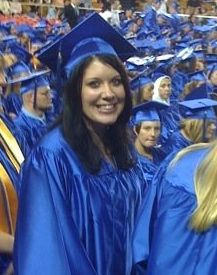
Shelly graduated Tulsa Community College (TCC) in May 2009
and earned her Bachelor's degree
from Northeastern State University (NSU) in 2011. Her long-term goal is
to earn a PhD. (Sometimes
it takes a while for some of us to get our heads on straight.
Be patient with your kids!) At this time, she is teaching at TCC while she completes her Master's
Degree from NSU (2013 graduation). She's decided that she wants to do some teaching and perhaps get a Master in Fine Arts degree before going on for her PhD. We are very proud of her, especially
her courage and tenacity to pursue this high calling. She
lives nearby in Tulsa, OK, supports herself and her two
cats, and pays for her college herself!
 |
 |
Shelly TCC Graduation May 2009 |
Cindy OSU Graduation Dec. 2009 |
My
husband and I had our 43rd anniversary in December 2013.
Although he has lost a lot of his vision and is legally
blind, he is active in volunteering and
taking care of me. He is going through vocational rehabilitiation
for the visually impaired and is otherwise enjoying his retirement.
After
I finished college, I went back to freelance writing and teaching.
I'm writing magazine articles, homeschool products,
book and iPhone reviews, and even working on a book or
two! You can read more about my writing adventures on my
personal blog. I'm also tutoring individual students and at local tutoring centers. You can
read about that on my professional
website.
Homeschooling
works, but in ways you may not imagine. It brought
us closer together as a family, gave us the faith
and persistence needed to get through the tough times
in life, and provided our children with the skills and
work ethics they needed to succeed in their life work.
I
hope my story will encourage you in your own homeschool
adventures. My story is not the perfect homeschool family
story that you often hear about at homeschool conventions,
but it is a story of courage, persistence, patience and
love. Our family has learned to accept each other for
who we are, depend on God during difficult times and
enjoy each other in spite of the challenges that happen
in life. We look forward to what God has in store for
us in the future and how He will help us to use not only
our successes, but also our mistakes for his glory.
. |
|
|
Copyright © 2004 -
Oklahoma Homeschool
|